
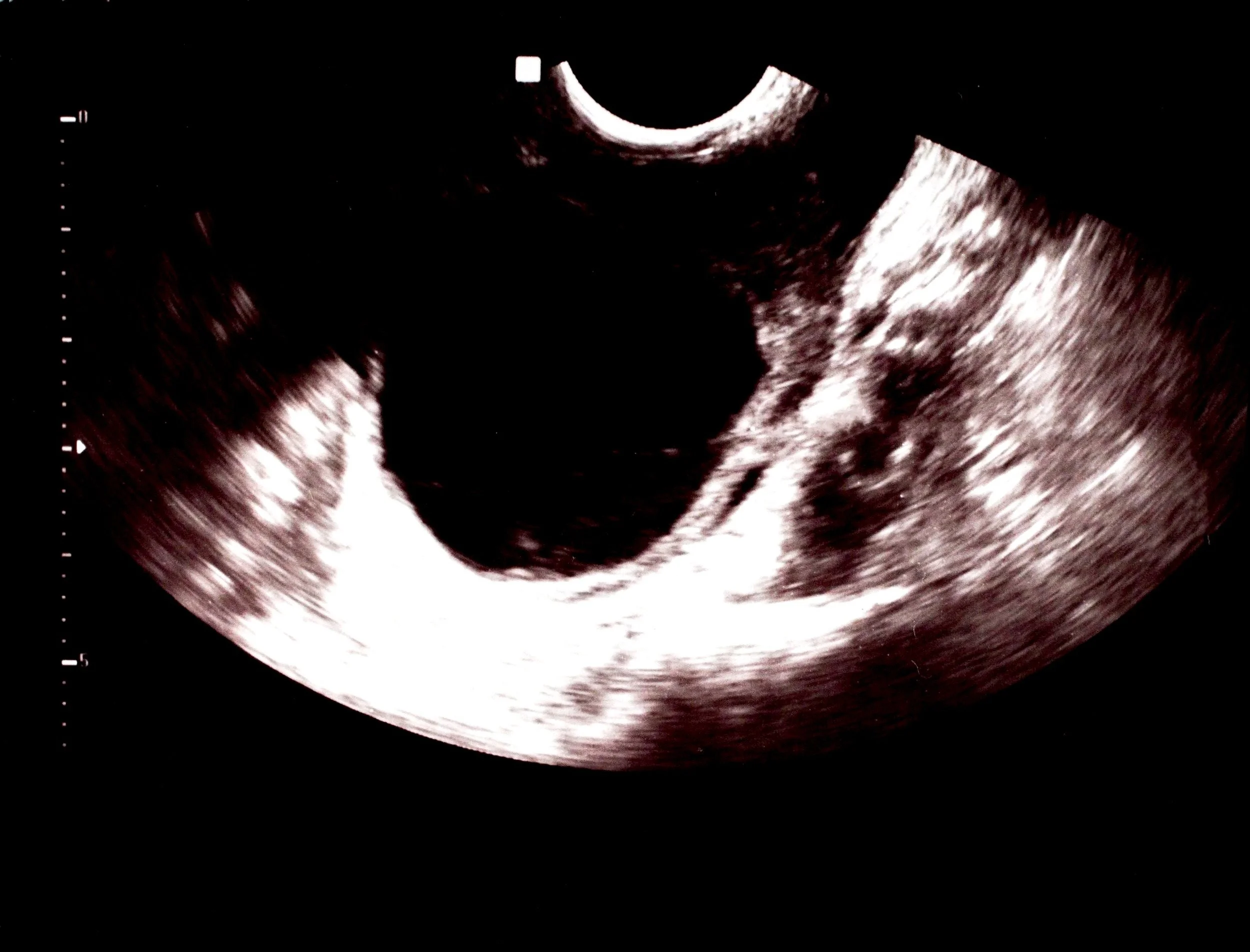
Ovarian cysts.
An ovarian cyst is a fluid-filled sac that develops on or inside an ovary. They are very common, especially in women of reproductive age, and most are benign (non-cancerous) and resolve on their own without treatment.
Ovarian cysts can be found incidentally on ultrasound or present with symptoms such as pain, bloating, or changes in periods.
Types of Ovarian Cysts
The most common types of ovarian cysts are:
Follicular Cyst
Develops when a follicle (the small fluid-filled sac that should release an egg) doesn’t rupture, and instead continues to grow and fills with fluid.
Very common and usually resolve on their own within 1–3 menstrual cycles.
Often cause no symptoms and are found incidentally on ultrasound.
Haemorrhagic Cyst
Occurs when a follicular cyst bleeds into itself after ovulation.
Sometimes causes sudden or one-sided pelvic pain and spotting or bleeding.
In most cases, the bleeding is self-limiting and the cyst settles over time without intervention.
Cystadenoma
A benign, thin-walled, fluid-filled cyst that arises from the surface of the ovary.
These cysts often do not go away on their own and can grow quite large.
Management depends on size, appearance on scan, and symptoms.
Dermoid Cyst (Mature Cystic Teratoma)
A benign tumour made up of different tissue types, such as hair, teeth, skin, or bone-like material.
They do not usually resolve on their own and, if larger than around 5 cm, are generally recommended for surgical removal to reduce the risk of twisting (torsion) or other complications.
Endometrioma (“Chocolate Cyst”)
A type of cyst caused by endometriosis when tissue similar to the lining of the uterus grows within the ovary and forms a walled-off cyst filled with old blood.
Endometriomas often become stuck to surrounding structures, such as the pelvic side wall, uterus, or bowel.
They commonly cause significant pelvic pain, painful periods, and sometimes pain with intercourse, and they do not resolve on their own.
Surgical excision (laparoscopic ovarian cystectomy) needs to be done carefully to remove the cyst while minimising damage to healthy ovarian tissue, especially if future fertility is important.
Investigations
The main test used to assess ovarian cysts is:
Pelvic Ultrasound Scan
Usually the first-line investigation.
Helps determine the size, number, and appearance of the cyst(s).
A transvaginal ultrasound generally gives the most detailed information.
In some cases, additional tests (such as blood tests or MRI) may be recommended depending on the ultrasound findings and your age.
Management
Management is individualised and depends on cyst type, size, appearance, symptoms, and your age and fertility wishes.
Conservative (Watch-and-Wait) Management
Suitable for many functional cysts (such as follicular or small haemorrhagic cysts).
Involves regular follow-up and repeat ultrasound to ensure the cyst is shrinking or resolving.
Pain relief (eg. simple analgesia) may be used where needed.
Surgical Management – Laparoscopic Ovarian Cystectomy
Recommended if a cyst is large, persistent, causing significant symptoms, or has features of concern.
Usually performed via laparoscopy (keyhole surgery) to remove the cyst while preserving as much normal ovary as possible.
Particularly important for dermoid cysts, larger cystadenomas, and endometriomas associated with pain or fertility concerns.
In some rare or complex situations, removal of the whole ovary may be recommended, but this is avoided whenever possible in younger women and those wishing to preserve fertility.
When to Seek Help
You should seek medical advice if you experience:
Persistent or worsening pelvic pain
A feeling of fullness, pressure, or bloating in your abdomen
Painful periods or pain with intercourse
Changes in your periods (heavier, irregular, or more painful)
Difficulty emptying your bladder or bowel
You should seek urgent medical attention (emergency department) if you have:
Sudden, severe pelvic or abdominal pain
Pain with nausea or vomiting
Pain with fever
Fainting, dizziness, or feeling very unwell
These symptoms may indicate ovarian torsion (twisting) or rupture, which can require urgent treatment.
How We Can Help
We offer comprehensive assessment and management of ovarian cysts, from monitoring simple cysts through to complex surgery where required. This includes careful evaluation with pelvic ultrasound, clear explanation of your results, and a personalised plan that considers your symptoms, age, and fertility goals.
Anna has additional surgical training in advanced laparoscopic (keyhole) gynaecological surgery, including complex ovarian cystectomy, endometriosis excision, and laparoscopic hysterectomy, offering patients minimally invasive options with quicker recovery, less pain, and smaller scars.
We work with you to decide whether a watch-and-wait approach or surgical treatment is most appropriate, ensuring you feel informed, supported, and involved in every step of your care.
Helpful links
-
Jean Hailes Ovarian Cysts
WEBSITE
-
NSW Ovarian Cysts Fact Sheet
PATIENT INFORMATION